
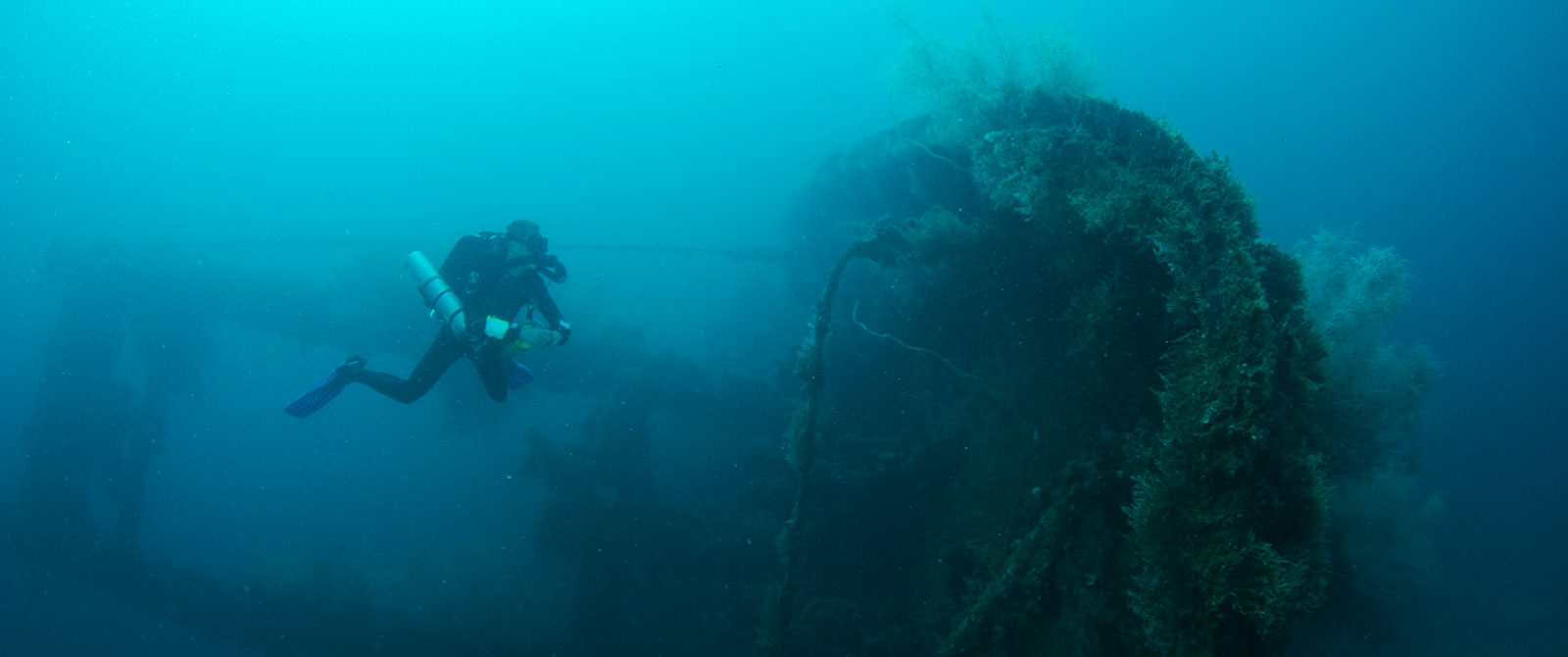
The Mogami Maru – “Pioneer”
It would appear that the wreck commonly known as the Pioneer by most dive operators on Malapascua is actually not that wreck. The ‘Pioneer Cebu’ was a passenger ferry which sunk in 1966,and was discovered and dived for the first time by Evolution in 2012.
The wreck which is a short distance north of Malapascua lying in 50m on a sandy bottom, is certainly not a passenger ferry and is almost certainly a Japanese vessel from WWII. The Mogami Maru was a fishing trawler of 50m length, completed in July 1941, and then converted to a submarine chaser before entering service for the Japanese Navy. Records show her to have been sunk after bombing in the Malapascua area on Sept 12th 1944.
We can assume that this wreck is the Mogami, partly due to her size, the length and beam have been measured to match very closely. Additionally the condition of the wreck is very similar to other wrecks sunk during the war, the decay of the steel, the proliferation of marine life, and the fact that there appears to be some kind of explosive damage in the stern section of the boat which would indicate she was sunk due to a bombing attack.
To add further evidence in support of this a number of items have been found on board with Japanese text on them, which would go even further to support these claims.
To dive the wreck today technical diving certifications are required. A maximum depth of 52m when the tide is high, mean you easily enter decompression while exploring the wreck, and with the shallowest part of the wreck around 45m there is a lot of blue water between the wreck and the surface. However this wreck is well worth a visit, although fairly small by wreck standards it is easy to spend the entire dive enjoying the small engine room which sustained massive damage before sinking – and in this are a number of interesting artifacts have been found. The propellor sits on the bottom half buried, with the destroyed stern around it a sign of the ships previous power.
As you move forward along the wreck there is a host of marine life crowded into the nooks and crannies of the ship for protection; expect to see schools of grunts, and anthias al over the coral covered midships, and watch out where you touch as the Mogami is home to at least 4 very large scorpion fish.
The midships section which would have supported the wheelhouse is collapsed down to deck level, and the helm has already been removed from the wreck by another diveshop to be displayed in their restaurant. Further forward there is a cargo hold which appeared to be carrying various electrical parts, along with oil drums. Much of this area is open and easily penetrated although no extensive penetration is possible due to the small size of the ship. Forward of the hold is the f’ocsle which shows the collapsed remains of an anti-aircraft gun mount. It seems that the gun has been removed at some point but the weight of the mount remained and assisted in the collapse of the upper deck area.
The forward bow section is nicely intact and the anchor windlasses can bee seen on both sides, with the chain still running down on both sides to the anchors which lie in position on port an starboard. The very tip of the bow supports a nice growth of soft coral sticking up towards the surface and providing a beautiful view if you have time to swim out in front of the bow and look back over the wreck as if she were steaming along the bottom towards you.


